

By Removing the Rivers of America, Magic Kingdom Forgoes Its Americana Roots

In the 70 years since Disneyland opened in 1955, the “castle park” has become a well-known theme park template. Despite their differences, a basic design structure ties together Disney’s disparate parks, including Tokyo Disneyland, Shanghai Disneyland, Magic Kingdom, and the original Disneyland Park, creating a style of park that is hard to define but easy to identify.
When you say “castle park,” specific images come to mind. There is usually a hub-and-spoke layout, different themed lands, and, of course, a castle. Still, the overarching and unifying theme of a Disney castle park is harder to pin down.

shanghai disney
When looking at the first two Disney parks, however, a much clearer theme begins to emerge.
Walt Disney’s View of Disneyland
When Walt Disney first introduced Disneyland to the masses, he made it explicitly clear that the park was both inspired by and dedicated to the American ideal.
“Disneyland is dedicated to the ideals, the dreams, and the hard facts that have created America, with the hope that it will be a source of joy and inspiration to all the world,” he said.

PHOTO: GENE LESTER/GETTY IMAGES
The America presented through Disneyland was not meant to be a realistic depiction of the country as it was. Instead, it was the America that Walt Disney believed in, presented through the lens of Disney’s team of WED magicians.
“Disneyland would be a world of Americans, past and present, seen through the eyes of my imagination – a place of warmth and nostalgia, of illusion and color and delight,” Walt would later explain.

Photo: Disney
Magic Kingdom Was Designed as an Idealized Version of the American Experience
This love of American history, spirit, and ingenuity would continue with the creation of Walt Disney World. Maintaining the basic layout of Disneyland, Magic Kingdom would lean even further into Americana with the creation of Liberty Square.

Photo: Imaginerding
For nearly 50 years, the park could only be understood as a collective through the prism of Americana. After entering Magic Kingdom, guests find themselves on Main Street, which is the quintessential small-town ideal and designed to evoke a sense of nostalgia in guests who grew up in the early 20th Century.

It is easy to forget that when both Disneyland and Walt Disney World opened, there were guests visiting the park who remembered a time when trolleys were a mainstream mode of transportation, horseless carriages were new, and the town square was where people gathered to conduct business.

Photo: Disney
For its part, Adventureland presents America’s post-war fascination with the unexplored world. Whether that be the tiki craze of the late 1940s and 50s (Walt Disney’s Enchanted Tiki Room), the remote Pacific islands waiting to be explored (Swiss Family Treehouse), or even the relatively uncharted wildernesses of Africa and South America (the Jungle Cruise).

Tomorrowland, in its early state, presented the endless possibilities of a future propelled by the American spirit and ingenuity. From space travel to the home of future living, there was always a great big beautiful tomorrow, shining at the end of every day.

Photo: Disney.
Fantasyland is, perhaps more than anywhere else, where Disney’s beloved movies truly come to life. Here, familiar characters appear around every corner, iconic songs fill the air, and timeless tales unfold before your eyes. Although many of these stories have European origins, they have been reimagined and popularized through Disney’s distinctly American perspective.
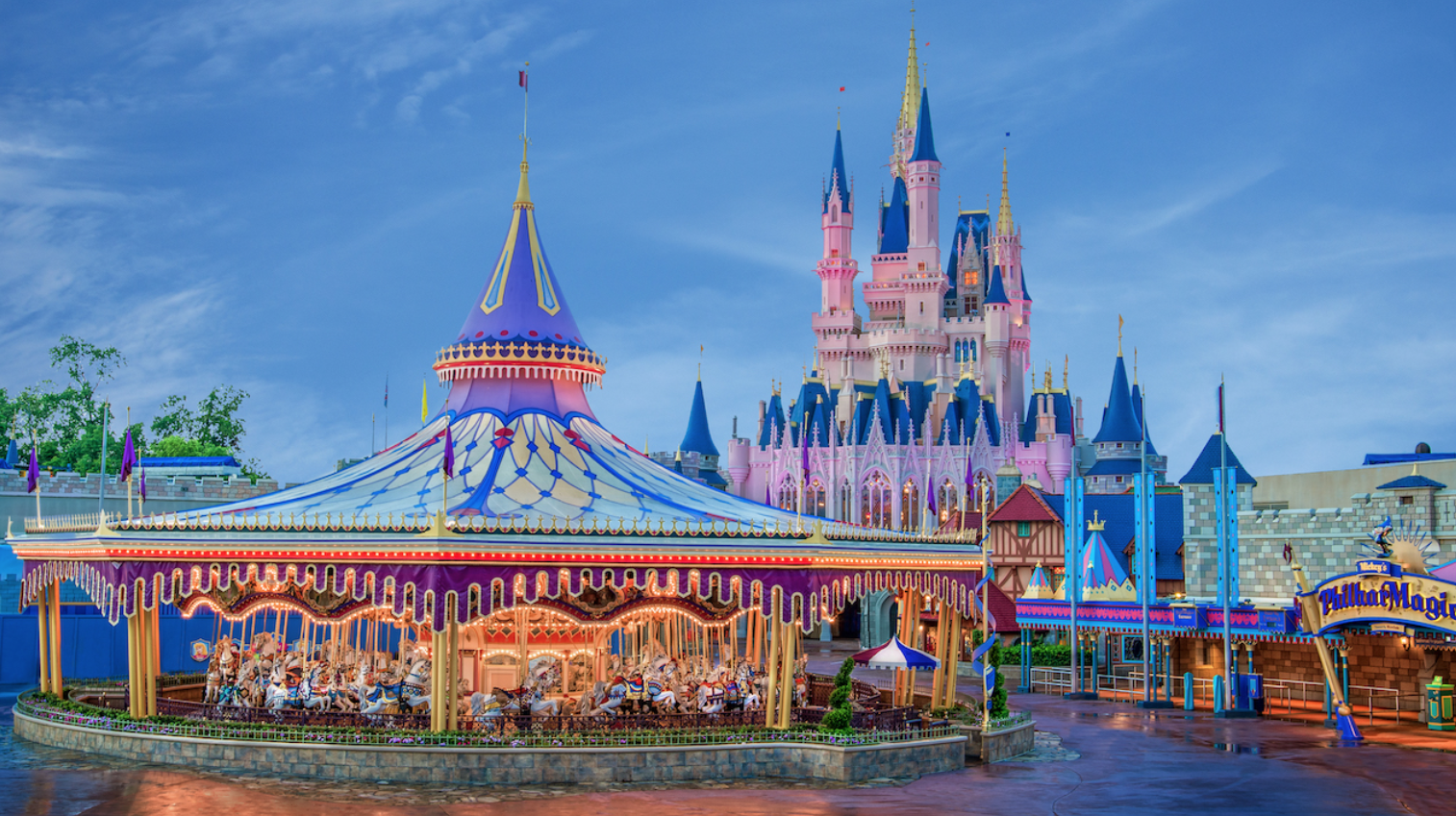
Photo: Disney
Whether due to the enduring appeal of the original tales or Disney’s remarkable storytelling, these narratives have become deeply woven into the fabric of American culture.
The Soul of Magic Kingdom
Then we have Frontierland and Liberty Square. Located on the Rivers of America, the northwest corner of Magic Kingdom was designed to follow America’s expansion west. The story begins in New York’s Hudson Valley (Haunted Mansion), works its way past the Mississippi River (Liberty Square Riverboat and Tom Sawyer Island), and eventually leads to the American West (Big Thunder Mountain Railroad).

The recent addition of Tiana’s Bayou Adventure aligned well with this westward movement. Now, guests are transported to New Orleans before they reach the mesas of Thunder Mountain.

Fueled by nostalgia, Magic Kingdom has presented the story of America for almost 55 years. The beating heart of that narrative has been the Rivers of America, which not only transports guests to the Mississippi River of the late 19th century but also allows guests to physically traverse and explore their environment.

In many ways, the Rivers of America is the connective tissue that holds the story of Magic Kingdom together. Combining the technology of the past, the stories that have become foundational to the American consciousness, and a dash of nostalgia, the Rivers and Tom Sawyer Island created the soul of the Magic Kingdom. They also grounded the experience of both Liberty Square and Frontierland.
Disney’s Gamble
By removing the Rivers of America and Tom Sawyer Island, Disney has made a deliberate choice to fundamentally alter the theme of Magic Kingdom and shift the park away from its Americana roots.
With this change, the Rubicon has been crossed, and there is no going back.

On the one hand, the decision should not come as a surprise. For years, Disney has signaled its discomfort with the Old West theming of Frontierland and the celebration of America’s (idealized) past that Frontierland once offered.

Frontierland Shootin’ Arcade
Over the last several years, we have seen Splash Mountain, the original Country Bear Jamboree, and the Frontierland Shootin’ Gallery all removed from the park. It was only a matter of time until Disney set its sights on Fort Langhorn and Injun Joe’s Cave.
The Focus Shifts to the Disney Brand
Since the current crop of Disney executives took charge, the winds of change have been evident at the Magic Kingdom. The goal is no longer to transport guests to immersive environments that draw inspiration from real-world settings, American literature, or nostalgia for the past.

Instead, Disney wants Magic Kingdom to exude the Disney brand, celebrate its IPs, and show the cutting-edge capabilities of Walt Disney Imagineering.
The park’s central aim is not to present distinctive lands that tell unique stories. It is to surround guests with their favorite Disney characters, songs, and sights. Sure, there will be a little window dressing, but going forward, the heart of Frontierland will look suspiciously similar to Fantasyland.

Credit: Disney
The Fantasylandification has not only come to Magic Kingdom’s other lands, but it has come to all of Walt Disney World.
After all, Walt Disney World is the same resort that boasts a Ratatouille attraction in the World Showcase, an upcoming Encanto attraction in Animal Kingdom, and a smorgasbord of Disney IPs at Hollywood Studios.

There will undoubtedly be a section, perhaps even a majority of fans, who will eagerly wait for the next shiny attraction based on a Disney movie.
For them, the Disney experience is all about the brand. The more Mickey, the better. Those guests have every reason to be excited, and I hope Piston Peak lives up to even the loftiest expectations.

Credit: Disney
For some of us, however, the Disney Difference has been stripped away as Walt Disney World increasingly replaces its legacy attractions with new, tech-based rides inspired by Disney films.
A High-Risk Move
For five decades, the Liberty Square Riverboat and Tom Sawyer Island were quintessential Disney attractions, synonymous with the kind of experience that could only happen at Disney.

Last Day on Tom Sawyer Island
There is no doubt that the new Cars land will be more popular than what came before it. The question for Disney is at what cost?
At this point, Magic Kingdom has forgone its central theme. Perhaps more importantly, it has also fundamentally changed the park where guests made their fondest memories for over 50 years.

Last Day on Tom Sawyer Island
The company is banking on the idea that its die-hard fans will still return, while the novelty of new attractions will bring in more first-time visitors. It is a perilous line to walk, however.
At some point, if you remove the essential elements from a park, it is no longer the same place. Guests who return to Disney time and again to relive their fondest memories may find that their emotional connection to the resort has weakened if not broken. After all, does Piston Peak mean more to a longtime Disney fan than Monsters Unchained?

Cinderella Castle in Magic Kingdom
In the end, Disney’s shift may pay off handsomely, as Disney World increasingly appeals to younger generations of fans who may not have grown up visiting the resort.
Without its monopoly on nostalgia and memories, however, the Magic Kingdom becomes just another theme park. That is the gamble that Disney was willing to take when it decided to remove the Rivers of America.

Liberty Square Riverboat on the Rivers of America.